Sir Gareth
Le Morte d'ArthurSir Gareth, also known as Beaumains, is the youngest of the Orkney brothers and one of the knights associated with King Arthur’s court. His story links the gradual revelation of his name and ability with a steadfast sense of fellowship: he rides with Sir Tristram and Sir Dinadan, refuses to join his brothers’ hostility toward good knights, and takes part in the adventures of the Grail quest. His position within the family makes that loyalty consequential, not merely ceremonial.
Identity and place in the court
The narrative identifies Gareth as one of the four sons of the Queen of Orkney, alongside Sir Gawaine, Sir Gaheris, and Sir Agravaine. She comes to King Arthur’s court with her sons while appearing to be a messenger, though her purpose is to spy on the court. At this point King Arthur does not know that she is his maternal sister. The account also connects the family’s history to Mordred, born of the Queen of Orkney and King Arthur, who likewise does not know their kinship at the time. Gareth therefore enters the narrative as part of a family whose concealed relationship to the king has consequences beyond his own career.
The chapter headings call him Gareth, “otherwise called Beaumains,” establishing that the name associated with his early court appearance and the name by which he is later known designate the same knight. The evidence gives no further account here of his childhood or of the circumstances behind the alias. It does, however, make the transition in names part of his recognizable plot: Beaumains arrives at court and seeks a place in its order, while the later adventures identify him as Gareth among his companions and peers.
Beaumains at Arthur’s court
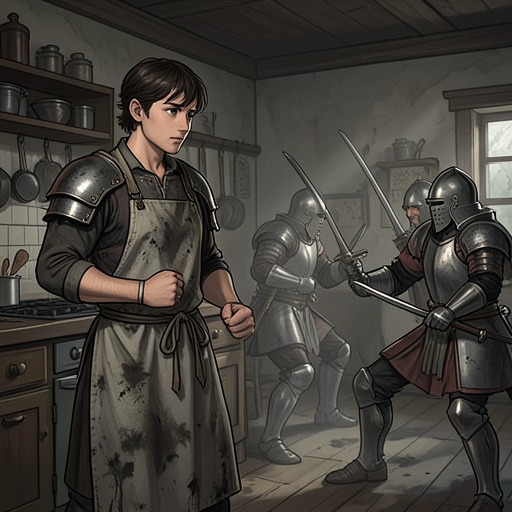
In the account of Beaumains’ arrival, he comes to King Arthur’s court and asks the king for three petitions. Sir Launcelot and Sir Gawaine are angered when Sir Kay mocks him. A damsel then asks for a knight to fight on behalf of a lady, and Beaumains requests the battle. When the king grants it, Beaumains also asks to be made a knight by Sir Launcelot. The episode ties his entry into courtly life to two linked claims: the right to undertake an adventure and the wish to receive knighthood from a distinguished knight.
The chapter sequence makes his progress concrete. Beaumains obtains a spear and shield from Sir Kay, then jousts and fights with Sir Launcelot. He subsequently tells Launcelot his name, is dubbed knight by him, and rides on to catch up with the damsel. The sequence moves from mockery and a borrowed set of arms to the disclosure of identity and formal recognition. The evidence establishes that Gareth’s passage into knighthood is not simply announced: it is staged through service, combat, and the granting of a name.
His adventures also acquire a comic dimension in the literary account of Malory’s humour. Beaumains is named alongside La Cote Male Taile as a subject of that humour, while the book’s broader comic incidents include the pranks played on Sir Dinadan and Sir Dagonet. This places Gareth’s story within a work that can treat knightly reputation and adventure with both seriousness and amusement; the evidence does not specify the individual comic episodes involving Beaumains.
Love, fellowship, and conflict with his brothers
A chapter heading describes Gareth coming into the presence of his lady, making her acquaintance, and entering into love with her. The supplied account does not name the lady in this passage or provide further details about the relationship. It does establish that the adventure associated with Beaumains’ emergence as Gareth culminates not only in recognition as a knight but also in a personal bond.
Later, Gareth rides with Sir Tristram and Sir Dinadan. When Sir Dinadan challenges a knight and is unhorsed, Gareth identifies himself as the youngest brother of Sir Gawaine. The two knights greet one another warmly and speak together about Sir Tristram, whom they have been calling cowardly because he has declined to fight. Soon afterward Gareth himself is unhorsed in a joust. Sir Tristram urges Sir Dinadan to avenge him, but Dinadan declines, explaining that the victor has defeated a larger and stronger knight than he is. Tristram then intervenes and unhorses the opponent. The episode sets teasing talk about courage against the practical risks of combat, while placing Gareth among companions whose fellowship survives their mockery and setbacks.
That companionship is tested by knowledge of Sir Lamorak’s death. Gareth says that Sir Gawaine, Sir Agravaine, Sir Gaheris, and Sir Mordred killed Lamorak in a private attack after Lamorak had been granted the prize at a tournament. The account says that Lamorak’s horse was killed, that the brothers fought him on foot for more than three hours, and that Mordred dealt him the fatal wound from behind. Gareth condemns the deed and says that, though the attackers are his brothers, he will never love them or join their company because they murdered a good knight. Sir Tristram agrees that he would have given much to have been present, while Sir Palamides recalls Lamorak’s prowess and griefs at his loss. The murder turns family identity into a moral test: Gareth does not deny his kinship, but he refuses to let it excuse treachery.
A knight who chooses his allegiance
At the tournament of Lonazep, Sir Tristram comes disguised in green armor and declines to tell King Arthur his name. When asked which side he will support, he answers that he does not yet know and will follow his heart when he reaches the field. Gareth is among the knights who ride with Tristram and Sir Palamides. In a joust, Gareth and Selises, a nephew of the King with the Hundred Knights, unhorse one another and are both hurt. Tristram and Palamides help Gareth back to their pavilion, where La Beale Isoud asks after him. The moment presents Gareth as a willing participant in the tournament, while also showing that the gathering’s allegiances are not settled in advance.
When the fighting becomes a confrontation between Arthur’s side and its opponents, Tristram decides that he will join King Arthur’s party. He tells Gareth, Palamides, and Dinadan that it would be shameful for knights of the Round Table to watch their lord and Sir Launcelot be dishonoured. Gareth and Dinadan approve and join Tristram in turning to Launcelot’s side; Palamides refuses to change sides. The change in allegiance is therefore both personal and collective: Gareth acts alongside Tristram and Dinadan, while Palamides’ refusal separates him from them for the moment.
The battle ends in the defeat and flight of the opposing parties. Sir Launcelot unhorses the King of Ireland, the King of Scots, and the King of Wales; King Arthur unhorses Palamides; and Tristram, Gareth, and Dinadan fight on the king’s side. Palamides leaves lamenting the loss of the honour he had gained and withdraws alone. Gareth’s role is not described as the decisive one in the victory, but his choice helps make the Round Table allegiance visible as an action rather than a label: when Arthur and Launcelot are threatened with dishonour, he joins their cause.
The Grail quest and the limits of fellowship
During the Grail quest, Gareth meets again with Sir Gawaine and Sir Uwaine. Gawaine has sought the way to follow Sir Galahad, but a monk tells him that Galahad will not accept his company because Gawaine is sinful. Gareth arrives while Gawaine is speaking with the monks, and the brothers rejoice at seeing each other. After hearing mass, Gareth and Gawaine set out together and meet Uwaine. The three promise not to part while on the quest unless fortune forces them to do so.
Their shared promise is tested at the Castle of Maidens. Its seven brothers attack the three knights because they have been driven from the castle by Galahad and mean to take revenge on Arthur’s knights. Gawaine kills one brother, and Gareth and Uwaine each kill another; together they defeat the remaining attackers. They then lose the route taken by Galahad and part from one another. The episode binds Gareth to the companions he has chosen, but makes their unity temporary: they can keep faith through the fight, yet the quest’s changing paths divide them afterward.
The Grail material also places Gareth’s actions beside a sharper judgment of knighthood. A hermit tells Gawaine that Galahad had defeated all seven brothers on his own the day before, and contrasts Galahad’s blessed life with the sinful lives of the other knights. The hermit interprets the Castle of Maidens and its seven attackers allegorically, associating them with souls imprisoned before the Incarnation and with the seven deadly sins. Gareth is present in the account of the three knights’ battle, but the hermit’s rebuke is directed at Gawaine; the evidence does not provide a separate verdict on Gareth’s spiritual standing. The contrast nonetheless defines the Grail quest’s demanding standard: fellowship and prowess matter, but they do not by themselves amount to spiritual purity.